
Inside innovation
Engineering Models vs. Flight Models
Engineering Models vs. Flight Models
19th October 2026
Article contents
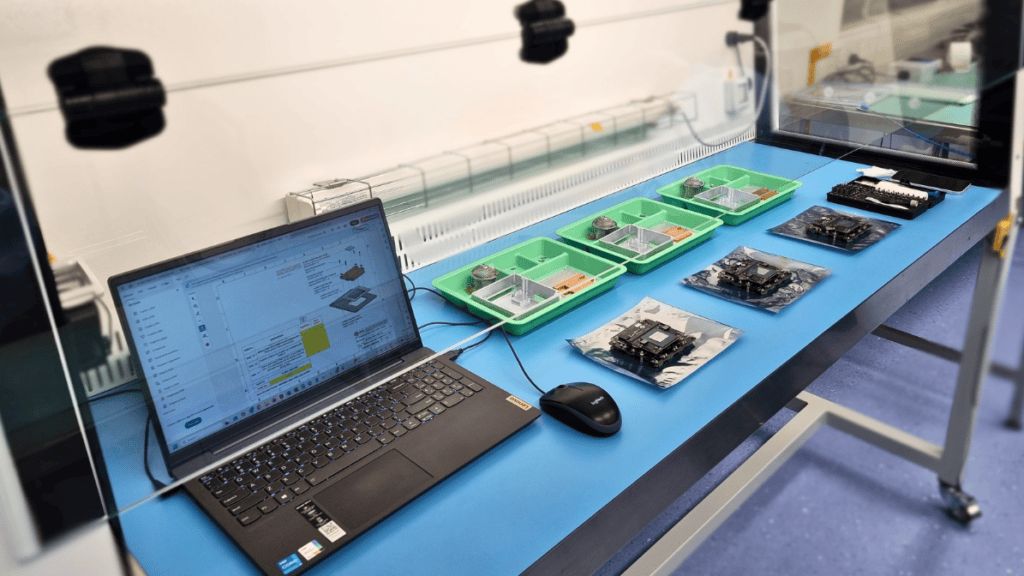
In space hardware, not every unit that comes off the assembly line is destined for orbit. NASA’s GEVS (General Environmental Verification Standard) and ESA’s ECSS handbooks have long formalised a staged approach to hardware maturity: Engineering Models (EM) and Flight Models (FM) serve different purposes in the development lifecycle.
At Infinity Avionics, the two that matter most for our customers are the Engineering Model (EM) and the Flight Model (FM). Understanding the difference helps customers know what they are testing, what they are buying, and what the documentation guarantees.
The Purpose of an Engineering Model
With Infinity Avionics products EM exists to evaluate the performance of the product at room temperature and to support software development and mechanical integration. It validates form, fit, and function, confirming that the electrical, mechanical, and software architecture behaves as intended before committing to the cost and lead time of a flight-qualified build. EMs are typically built to the same functional architecture as flight hardware and go through many of the same fundamental processes: incoming inspection, cleaning, and functional testing. However, an EM is not the flight configuration. FM product specifications, including operating temperature range, radiation performance, shock and vibration performance, and outgassing data, do not apply to EM hardware.
Because EM hardware is not configuration-controlled to the same standard as flight hardware, it may include any of the following, provided the hardware still meets fit, form, and function requirements at room temperature:
- Flight units that were down screened because of thermal or optical performance limitations, or other non-conformance reports, where the limitation 1 does not affect fit, form, or function at room temperature.
- Components with unknown outgassing performance.
- Components that have not been validated end to end across the full operating temperature range.
- Components with materials unsuitable for vacuum.
- Components built to lower-grade manufacturing specifications.
- Mechanical parts that do not meet the specified surface finish or tolerances.
- Optical components with similar performance to the flight units but a different construction.
The Purpose of a Flight Model
A Flight Model is where the design is translated into hardware that is qualified to fly. FM hardware comes with workmanship standards such as IPC Class 2/3 for printed circuit assemblies, flight-grade mechanical finishing and coatings, thermal cycling to up-screen subsystems/ assemblies and, for optical systems, space qualified optical assemblies rather than commercial equivalents. FM units go through extended functional testing, validated performance across the complete operating temperature range, and assembly within a controlled clean environment.
Every FM is built to the same configuration as the units that went through thermal vacuum, vibration, and shock testing, and it complies with the full interface control document (ICD) and Declared Material List (DML).
Infinity Avionics does not use radiation hardened or MIL spec components for FM products unless specified otherwise. We follow a carefully selected electronic COTS components-based approach combined with additional single event protection, redundant subsystems, and radiation shields to support the required radiation performance of FM hardware.
EM vs FM Distinction
An EM lets a team validate integration and operations early and at lower cost, without consuming flight hardware. An FM gives the customer confidence that the unit has been built, tested, and controlled to the standard its ICD describes.
In case you are not sure how to use our EM and FM hardware to meet your specific mission needs and risk profile, please reach out to us.