
Inside innovation
On-Orbit Sensor Fusion: Powering Autonomous Space Missions with BRAIN
On-Orbit Sensor Fusion: Powering Autonomous Space Missions with BRAIN
18th March 2026
Article contents
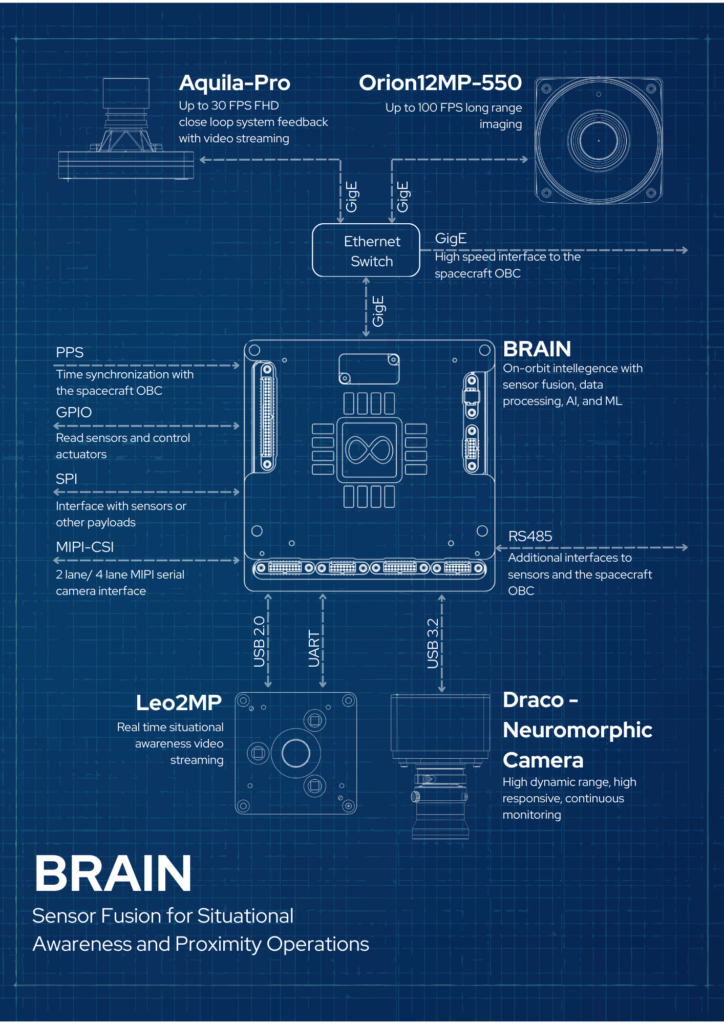
In the rapidly evolving NewSpace economy, complex operations like Rendezvous, Proximity Operations, and Docking (RPOD), in-space manufacturing, and debris removal demand more than just raw data—they require real-time, actionable intelligence. Central to this capability is the Infinity Avionics BRAIN processor, a high-performance edge computing platform designed to act as the “central nervous system” for advanced satellite payloads.
Built on the NVIDIA Jetson Orin NX architecture, BRAIN provides up to 100 TOPS of AI performance, allowing it to process diverse sensor feeds simultaneously and make autonomous decisions without waiting for ground-based instructions. Combined with the range of Infinity Avionics cameras, BRAIN provides an all-in-one solution for complex orbital intelligence.
Different Sensors for Different Needs
A successful proximity operation requires different visual perspectives at different mission phases. BRAIN manages this through its versatile multi-protocol architecture:
• Long-Range Detection with Neuromorphic Sensing (Draco via USB 3.0):
Utilizing high-dynamic-range (HDR) neuromorphic cameras like Draco, BRAIN can detect and track target objects at a distance. The high-throughput USB 3.0 interface ensures low-latency data transfer to support real-time detection and tracking.
• Feature Extraction with Visible Spectrum Sensing (Orion12MP-550 via GigE):
For precise identification, BRAIN can be combined with the Orion12MP-550. Its narrow Field of View (FoV) captures the fine details necessary for identifying docking ports or structural anomalies. BRAIN’s GigE interface can connect to multiple cameras through an Ethernet switch, allowing mission designers to scale the system with ease.
• Situational Awareness (Leo2MP via USB 2.0/UART):
General monitoring and “big picture” awareness are handled by one or more Leo2MP cameras. Its wide FoV provides the context needed to ensure the host spacecraft remains clear of obstacles while providing real-time image streaming for control loops.
• High-Speed, High-Resolution Monitoring (Aquila via GigE):
The Aquila camera provides Full HD video at 30 FPS, supporting both compressed and uncompressed streaming. This low-latency stream serves as a primary input for control algorithms implemented on the BRAIN platform, offering real-time visual feedback for robotic arms or docking mechanisms.
• Comprehensive Sensor Support (MIPI-CSI, RS485, SPI, GPIO):
Beyond primary cameras, BRAIN supports additional mission-critical hardware such as proximity sensors, star trackers, and thermal cameras.
The Architecture of Integration: Synchronisation and Control
Sensor fusion is more than just connecting hardware; it is the deterministic synchronization of data and physical action.
• Time Synchronisation (via PPS):
BRAIN receives a Pulse Per Second (PPS) signal from the spacecraft’s On-Board Computer (OBC). This is essential to synchronise multiple sensors and actuators with the spacecraft’s Attitude Determination and Control System (ADCS).
• Command and Control (via RS485 & Ethernet):
BRAIN communicates processed intelligence back to the spacecraft OBC via the robust RS485 or high-speed GigE interface. Simultaneously, it can use its GPIOs to directly trigger actuators, such as thrusters or robotic arms, based on the results of fusion algorithms.
AI and Machine Learning at the Edge
The BRAIN processor leverages its NVIDIA Ampere GPU architecture to run sophisticated models that drive autonomous operations. Users can implement:
• Object Detection & Classification: Identifying targets and debris.
• Pose Estimation: Determining the 3D orientation of a target for docking.
• Navigation & Actuator Control: Implementing real-time GNC (Guidance, Navigation, and Control) algorithms directly on the payload.