
Inside innovation
Choosing the Right Monitor Camera: SelfieCam vs. Leo2MP vs. Aquila
Choosing the Right Monitor Camera: SelfieCam vs. Leo2MP vs. Aquila
22nd June 2026
Article contents
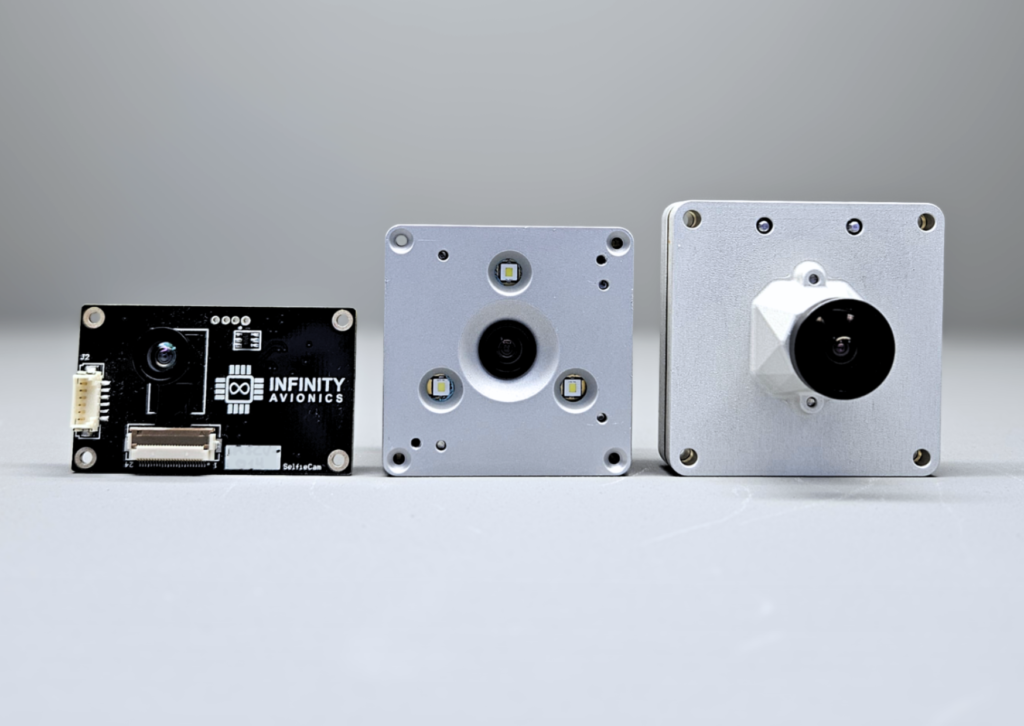
Spacecraft monitor camera requirements vary significantly depending on mission phase, payload mass budget, and visual requirements. Infinity Avionics provides a comprehensive suite of three purpose-built monitor cameras, SelfieCam, Leo2MP, and Aquila, designed to support fast integration and rapid deployment while providing reliable and detailed imagery to enhance space situational awareness.
In addition to the proven performance, our monitor cameras feature:
- Fast Evaluation: Available with debug cables and Python-based scripts for performance assessment within minutes.
- Integration Head-Start: Python scripts serve as a direct starting point for your spacecraft interface software.
- Quality Assured: Manufactured with IPC Class 3 PCBs, individually thermal stress tested, and fully functionally tested.
- Comprehensive Documentation: Includes ICD, Command & Telemetry Handbook, CAD files, cable drawings, Quick Start Guide, Declared Materials List (DML), and unit-level test reports.
SelfieCam: Proven, Low SWaP, and Easy Integration
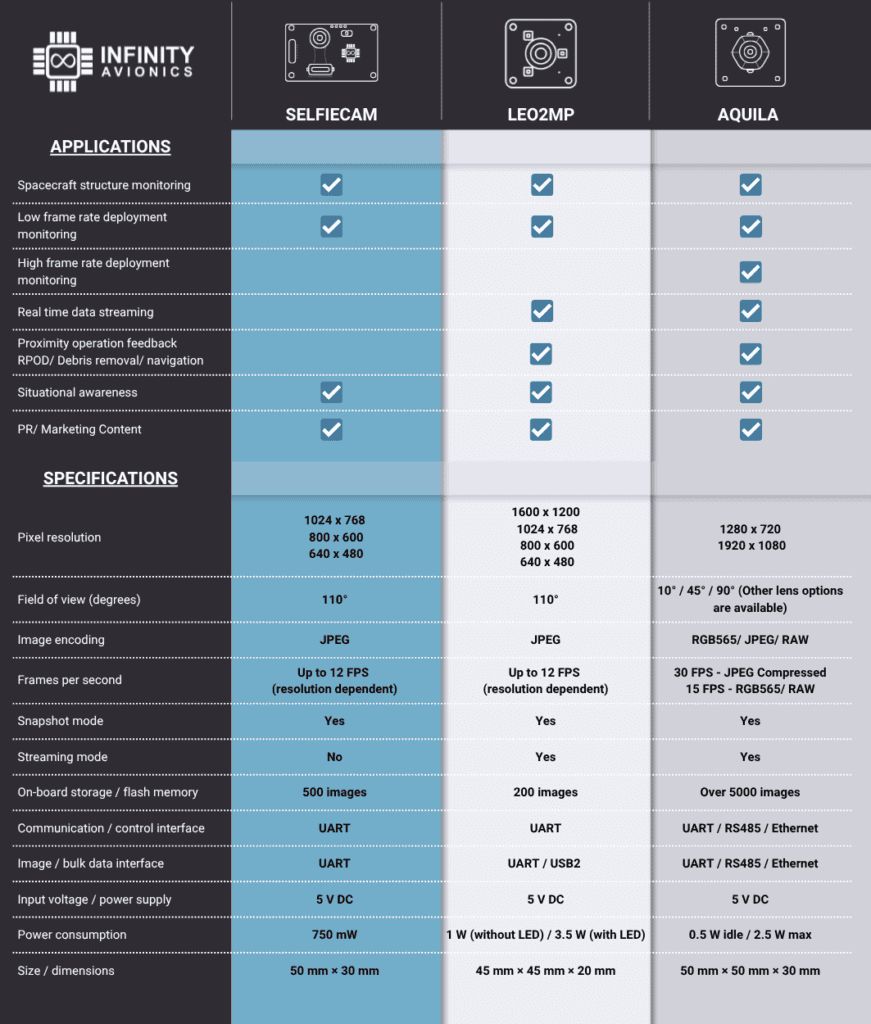
SelfieCam is built with very small form factor and low weight to support SWaP constraint space missions. At just 10 g and 750 mW, it’s the lightest and lowest-power camera in the line, built around a wide 110° field of view and resolution options up to 1024 x 768. SelfieCam supports up to 12FPS image capture and storage.
SelfieCam’s communication interface is deliberately minimal with a UART interface to support control and data retrieval. The camera captures JPEG compressed images to avoid burdening valuable downlink bandwidth especially during the initial spacecraft commissioning stages. SelfieCam provides on-board storage for up to 500 images.
The camera has been flight-proven since 2018 and qualified to sustain the harsh space environment (Thermal vacuum, vibration, and shock). Additionally, the camera was tested up to 30kRad TID without affecting the functionality.
Best suited for: Deployment confirmation (solar panels, antennas, separation events), CubeSat and small-satellite missions with tight mass and power budgets, and any application where low frame rate JPEG compressed images/ video clips are sufficient.
Leo2MP: Proven, 2MP resolution, LED illumination, with Data Streaming
Leo2MP steps up in capability while keeping the same 110° field of view and compact form factor philosophy of SelfieCam. Resolution increases to 1600 x 1200, and critically, Leo2MP adds image data streaming capability over USB2 interface. This makes it suitable for missions that need to monitor an event as it happens, not just capture a still afterward.
With its compact form factor, Leo2MP weighs 65 g and consumes up to 3.5 W with onboard LED illumination active (1 W without). The camera can store up to 200 images on-board while supporting image data streaming at up to 12 FPS.
Leo2MP is at TRL9, with a track record of unique on-orbit imaging capability. The camera has undergone thermal-vacuum, vibration, and shock qualification, and has been tested to 30kRad TID without affecting functionality.
Best suited for: Real-time deployment or docking monitoring where ground teams or onboard systems need a live feed, missions operating in low-light conditions (thanks to the onboard LED), and platforms with USB2 connectivity already in the data architecture.
Aquila: FHD, Data Streaming, and Customisable
Aquila is designed to support ever increasing high resolution, high frame rate imaging needs to support on orbit manoeuvre monitoring, space robotics, and space situational awareness applications. It supports HD and Full HD resolution (1280 x 720 / 1920 x 1080) at up to 30 FPS, with selectable field of view options (10°, 45°, or 90°, plus custom lens options), letting one camera family serve both wide-context monitoring and narrow-FOV inspection tasks depending on lens choice.
Connectivity is Aquila’s standout feature: alongside UART, it supports RS485 and full Ethernet, with image streaming over Ethernet and over 5,000 images of on-board storage. Image encoding options expand to RGB565, JPEG, and RAW, giving downstream processing more flexibility depending on the mission needs.
Best suited for: Space situational awareness, RPOD (rendezvous, proximity operations, and docking) and inspection missions needing variable FOV optics, missions requiring networked Ethernet architectures with multiple cameras or sensors, applications needing high frame rate HD video rather than still captures.
Which Camera Is Best For Your Mission?
If mass and simplicity are the overriding constraints and you need straightforward and proven visual confirmation, SelfieCam is the obvious choice. If you need a compact footprint but with a live feed and better low-light performance, Leo2MP is the natural step up. And if your mission calls for high-resolution video, flexible optics, or a networked sensor architecture Aquila offers a level of capability the other two aren’t designed to provide.
All three share Infinity Avionics’ core design philosophy: space-qualified, integration-ready hardware that drops into a mission architecture without demanding significant engineering time and effort.